
The Five Adjustments Behind Andy Pages’ Dream Start
Five key changes in discipline, swing, and pitch recognition explain Andy Pages’ dominant start and point toward sustainable production beyond April.

Justin Wrobleski just fired eight scoreless innings against the Mets. It’s the best outing by a Dodgers starter so far in 2026. But after the game, it wasn’t the left-hander’s numbers that intrigued me most. It was what Cuban center fielder Andy Pages said through interpreter Juan Dorado:
“When a pitcher is executing that well, I get a great view of what he’s doing with his pitches. It’s nice to be out there when a guy’s throwing the way he is.”
That seemingly simple quote holds the key to what’s happening with Pages early in the 2026 season. Because a center fielder who sees pitches that well from 380 feet away is seeing the ball better than almost anyone when he steps into the batter’s box.
Through 16 games, Pages leads MLB with a .417 batting average, 25 hits, and 20 RBIs, after launching a three-run homer off left-hander David Peterson in the Dodgers’ 4–0 win over the Mets on Monday night. It was his fifth home run, and he now ranks second in total bases (44) and third in both slugging (.733) and OPS (1.186). He leads the National League in average and hits. His wRC+ stood at 233 entering the game.
The question, of course, is whether this is just a hot April streak. It might be. But a deeper dive into Pages’ early trends points to something more compelling: a new approach, a new philosophy. A series of early adjustments that, if sustained, could render his 2025 numbers a baseline rather than a ceiling. It’s April, yes—but here are the five adjustments driving this breakout.
Adjustment #1: Fewer swings, better swings
In 2025, Pages swung at 53.1% of the pitches he saw. In 2026, that’s down to 47.8%. Not a massive drop, but a meaningful one: fewer swings per plate appearance.
More importantly, his Z-Swing% (swings at pitches in the strike zone) has dropped from 70.5% to 66.9%. He’s letting strikes go—specifically marginal ones that often lead to weak contact.
The result: his walk rate (BB%) has climbed from 4.6% to 6.7%. Still modest, but clearly improving. His strikeout rate (K%) has only ticked up slightly, from 21.6% to 23.3%. He’s not paying for patience with excessive called strikes.
And we already know what Pages did in 2025:
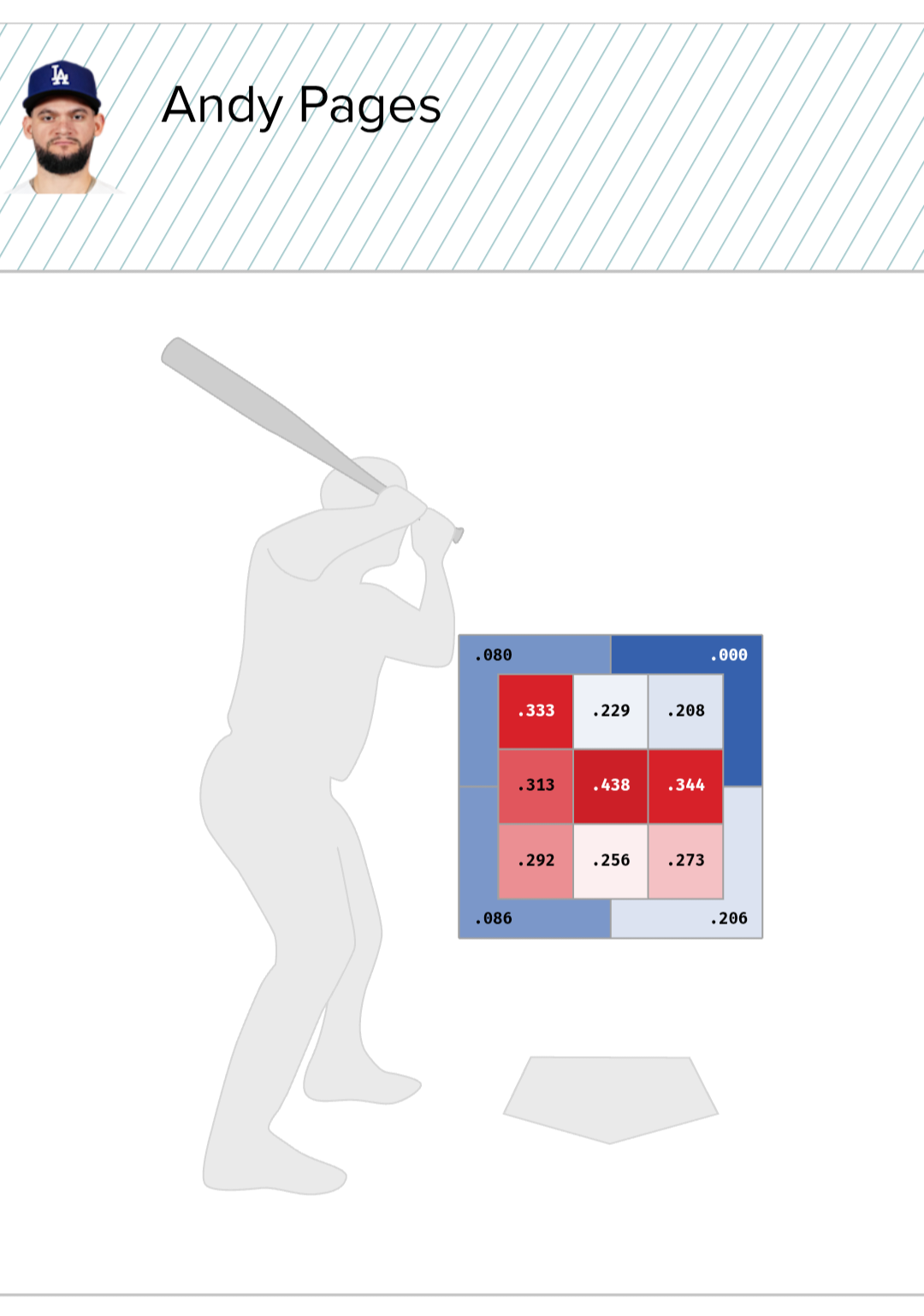
He crushed pitches on the inner edge of the zone. That’s not something every hitter can do. Pitchers study tendencies constantly. Pages knows he can drive inside pitches—and so do his opponents.
Batter: Pages, Andy
Pitcher: Gallen, Zac
Count: 1 - 2
Pitch Type: KC
Velocity: 81.8
Exit Velocity: 100.6
Hit Distance: 400
HR: 28/30 parks
Matchup: AZ @ LAD
Date: 2026-03-26
In a 1–2 count against Zac Gallen, who throws a knuckle-curve 22% of the time in two-strike situations, Pages simply waited, recognized the breaking ball, and destroyed it.
Batter: Pages, Andy
Pitcher: Lord, Brad
Count: 1 - 1
Pitch Type: FF
Velocity: 94.5
Exit Velocity: 100.3
Hit Distance: 387
HR: 26/30 parks
Matchup: LAD @ WSH
Date: 2026-04-04
Against Brad Lord, who tried to elevate a fastball in a 1–1 count, Pages punished a pitch that leaked just enough over the plate. A well-executed pitch there might limit damage—but miss by inches, and it becomes dangerous. Pages made it costly.
Four of his five home runs have come on pitches left over the heart of the plate or nearby—where his swing is lethal. His only relative weak spots are high-and-away and low-and-away zones, but even elite hitters struggle to dominate every quadrant. What stands out is his consistency: he handles up-and-in, down-and-in, and anything left in the middle—and he can still do damage when he correctly reads breaking balls on the outer edge.
Adjustment #2: A flatter swing, harder contact
Bat-tracking data shows Pages has adjusted his attack angle. In 2024–25, it ranged between 8 and 10 degrees. In 2026, it’s down to 7.
That means a slightly flatter swing. His ground-ball rate has risen from 35.4% to 38.1%, while his fly-ball rate has dipped from 42.3% to 40.5%.
The immediate effect: harder contact. His average exit velocity has jumped from 88.6 mph to 91.0 mph. His HardHit% has surged from 37.2% to 52.4%.
More than half of his batted balls now leave the bat at 95 mph or higher—elite territory.
