
The Nightmare Continues
Echoes of the World Series: Dodgers overwhelm Blue Jays pitching and send a message

Happy post-Easter week to everyone. What happened last night in Toronto felt familiar long before the final score made it obvious. This wasn’t just a 14–2 win—it was a continuation. The same matchup, the same setting, and, at least for one night, the same dynamic that defined the 2025 World Series: the Dodgers in control.
The Dodgers returned to the stage where they were crowned champions and did so without hesitation, imposing their rhythm from the first pitch to the final out in a 14–2 win that, beyond the lopsided scoreline, delivered a message that’s hard to ignore. Because while the margin stands out, what truly matters is the trend beginning to take shape in these early days of the season.
Just a week ago, there were reasonable questions about the Dodgers’ offense after a series against Cleveland in which they managed only seven runs across 27 innings. It was the kind of small sample that tends to inflate concerns in April but rarely defines a lineup of this caliber. All it took was a trip to Washington to flip the narrative: 31 runs in three games, an offensive explosion that has now carried over into Toronto.
With 14 runs last night, the Dodgers have now scored 45 in their first four road games—a number that not only signals a hot stretch but ventures into historic territory as the highest total by any team over that span since 1900. In other words, no team has produced at this rate in the last 126 years. At this point, this is no longer a fleeting surge, but an offense beginning to show both consistency and depth.
Within that collective display, Dalton Rushing emerges as the most compelling story of the night. His line—4-for-4, two home runs, five times on base—marks the best performance of his young Major League career, but what makes it particularly meaningful is the context in which it occurred.
Rushing arrived in the majors as the organization’s top prospect, yet his first experience was shaped by the irregularity inherent to his role: sporadic appearances, difficulty finding rhythm, and limited production that reflected his situation more than his talent. It’s not easy to develop when you’re not playing every day, and that was precisely the reality he had to navigate during his rookie season.
Rather than stagnate, the catcher used the offseason to make both mechanical and mental adjustments. He simplified his swing, worked toward a more repeatable foundation, and, most importantly, focused on how to remain competitive without daily at-bats. That kind of adaptation—often invisible—is what separates players who survive from those who evolve.
The opportunity he received in Toronto, initially part of a planned strategy to give Will Smith some rest, turned into an unexpected platform. Rushing didn’t just respond—he controlled the game in every plate appearance, displaying a confidence that Freddie Freeman himself highlighted as one of his defining traits. Rushing even joked afterward that nights like this aren’t sustainable, but made it clear he intends to ride the wave for as long as possible.
His second home run of the night may have been the most impressive. Spencer Miles opened the at-bat with a curveball on the outer edge, which Rushing took. Then came a 96 mph fastball in near his right elbow for ball one. At 1–1, Miles went back inside with a curveball, returning to the same area but changing speed and movement. Rushing crushed it—a no-doubt 30/30 homer that traveled 413 feet.
He did it with a 76 mph swing—quick, compact, and, most importantly, reflective of his new approach. He let the curveball travel, recognized it in time, and then unleashed.
Beyond his performance, the Dodgers’ power once again showed up as a collective force. Teoscar Hernández set the tone early and finished with four RBIs, while Freddie Freeman added another towering blast—a 438-foot shot that extended the lead and sustained the pressure on opposing pitching.
The Baseball Savant breakdown says it all.
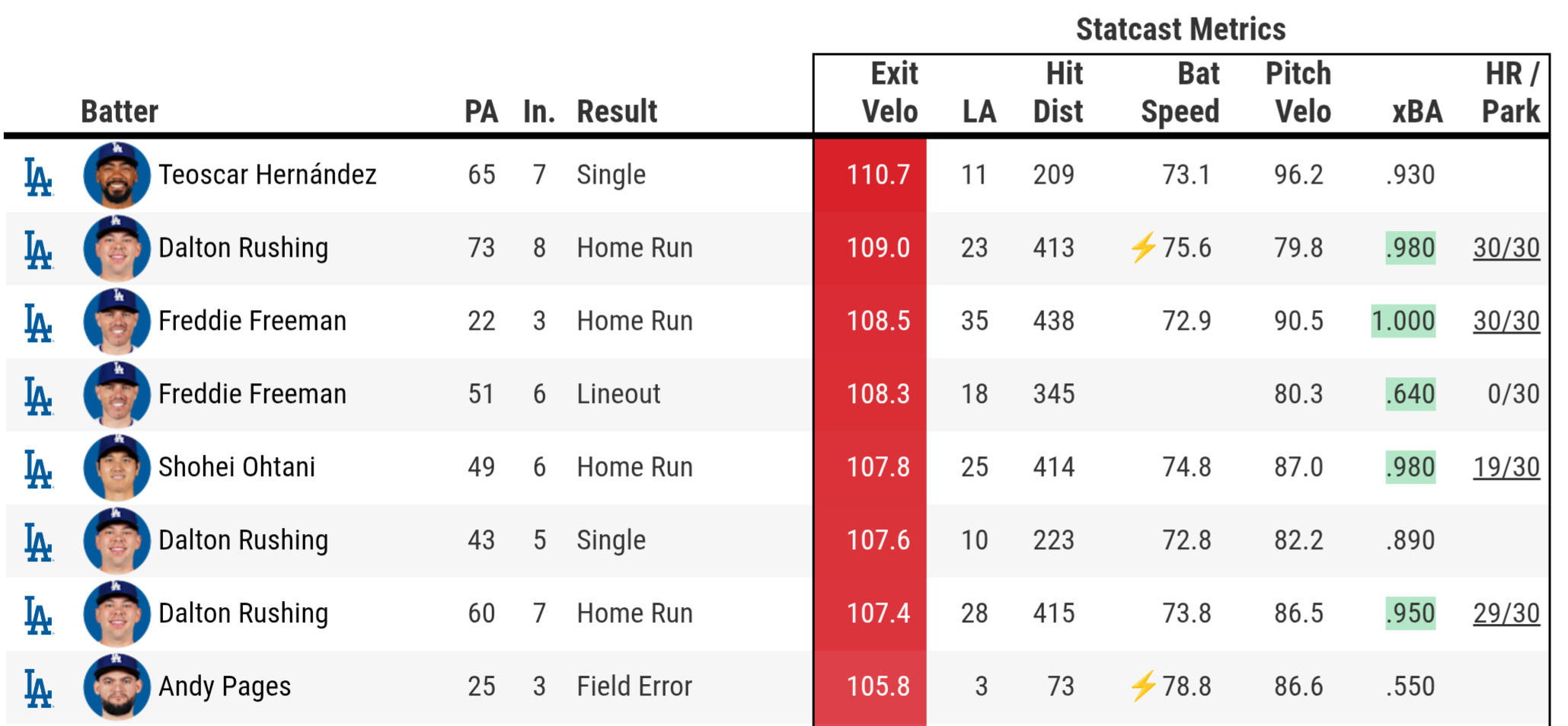
But before getting to the latest chapter in Shohei Ohtani’s already legendary career, it’s worth highlighting one detail about Hernández’s home run.
If you were watching, you understand why opposing pitchers simply cannot afford certain mistakes. With two outs in the top of the first inning, Max Scherzer started Hernández with an inside fastball—something he often does—before landing a slider on the outer edge. The problem? The slider hung over the middle of the plate, and Hernández crushed it.
Every pitcher misses location at times. That’s part of the game. But this is what happens when you miss against the Dodgers.
Consider this:
Teams with the most home runs on middle-middle pitches since 2024
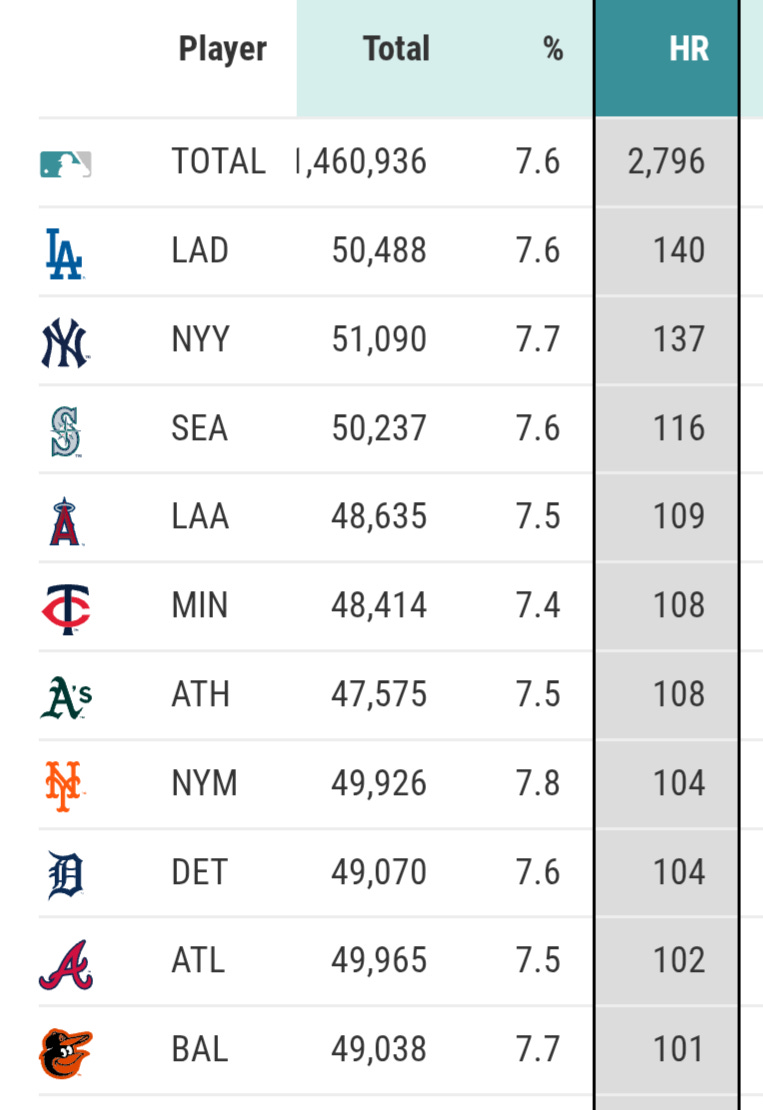
No team in MLB has hit more home runs on pitches left over the heart of the plate than the Dodgers, who have punished those mistakes with 140 homers. The Yankees follow with 137, and Seattle sits further back at 116.
Now take it a step further:
