

At some point during these first weeks of the season, as Munetaka Murakami kept piling up home runs with a natural ease that seemed to defy the context of a Major League debut, the conversation began to drift to the usual place: his talent, his swing, his transition, his apparent immunity to adjustments. It’s an understandable reaction. Thirteen home runs in 32 games will push anyone toward exaggeration.
Murakami finished Friday night with a .967 OPS after hitting his 13th home run of the season in the White Sox’s 8–2 victory over the San Diego Padres, breaking the tie for the league lead he had shared with Yordan Álvarez and Aaron Judge.
How much do those 13 home runs really tell us? This is where we begin, because that number is also part of a strange but legitimate trend worth appreciating: Murakami has 13 extra-base hits. Yes—all of his extra-base hits have been home runs. No doubles. No triples. He has been a pure home run hitter.
Now, let’s dig a little deeper. When we stop and look at the heat maps, contact profiles, and pitch-type splits, the story that emerges is more uncomfortable: Murakami is not dominating every zone… he is punishing very specific mistakes that keep being repeated.
The league is not being overpowered. The league is being imprecise.
And that imprecision can be summarized in three clear sins.
1. Continuing to live in the middle of the zone with the fastball
The first sin isn’t sophisticated, but it is persistent: the insistence on attacking with fastballs in the zone, especially in the heart of the plate or slightly inside.
At first glance, a .263 average against the four-seamer might seem manageable. But that number loses meaning when placed alongside a .658 slugging percentage, an OPS north of 1.000, and a 205 wRC+. What Murakami is doing against the fastball isn’t about hitting often… it’s about doing damage every time he connects.
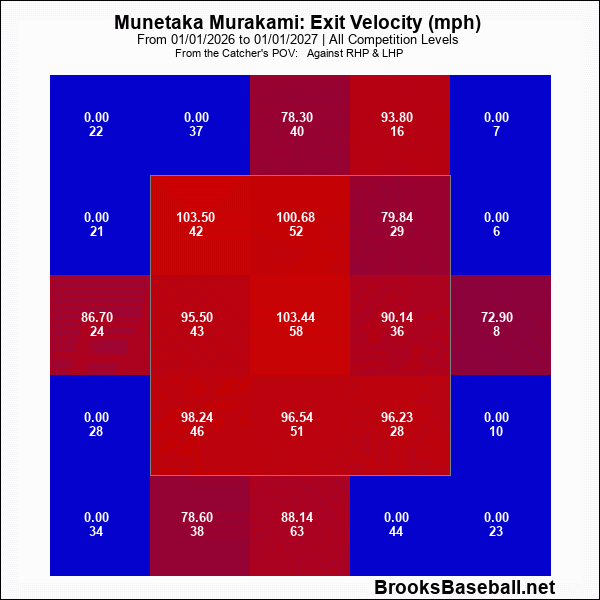
The heat maps explain it better than any stat line. In the middle of the zone, the ball comes off the bat with sustained violence—over 103 mph—and the results skew heavily toward extra-base hits and home runs. Murakami is crushing mistakes there, especially when pitches drift into the upper part of the zone. It’s a region of the plate where his swing finds its optimal extension and angle.
What’s truly puzzling is that nearly half of the fastballs he sees are still landing in the zone, and his in-zone swing rate sits around 78%. In other words, pitchers continue to offer exactly the kind of pitch Murakami is ready to attack from the very first move.
This is not about pitch selection. It’s about repeatedly poor location.
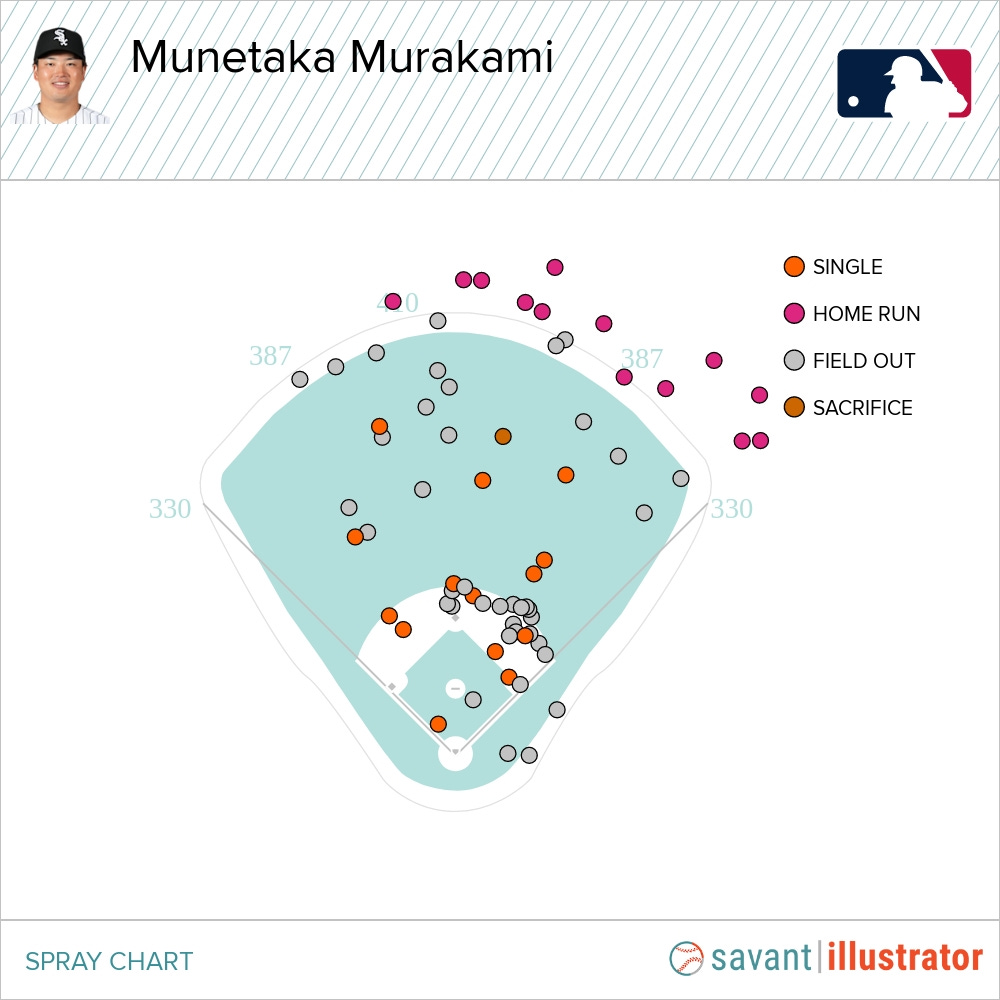
2. Believing any breaking ball is an adjustment
The second sin is born from a well-intentioned but poorly executed idea. Recognizing that fastballs in the zone are dangerous, many pitchers have increased their use of breaking balls. In theory, it’s a logical adjustment. In practice, it has been inconsistent.
The slider, when properly located, does represent a partial solution. The numbers are clear: a .111 average, over a 50% strikeout rate, and a whiff rate above 25%. There’s a simple reason for that: the effective slider against Murakami is the one that threatens the zone and finishes outside it, forcing a late and uncomfortable decision.
The problem arises when that principle breaks down.
The changeup (.333 AVG, 1.145 OPS), the curveball (.333 AVG, 1.067 OPS), and especially the cutter (.500 AVG, 2.071 OPS) all show that it’s not enough to vary speed or movement. When those breaking pitches stay in the zone—and the data suggests that happens often—the effect is not to neutralize contact, but to recreate the ideal conditions for his swing, just at a lower velocity.
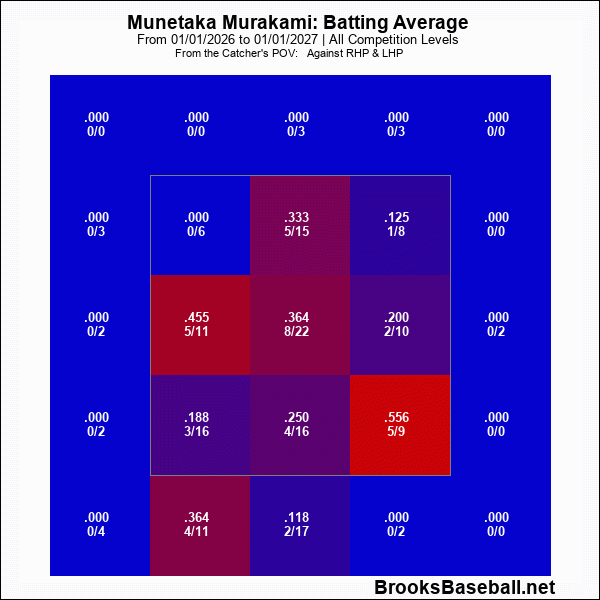
On the maps, those middle and lower zones light up again, regardless of pitch type.
Murakami is not being confused by variety. He is being rewarded by poor execution within that variety.
3. Misreading the lower zone as a safe haven
The third sin runs deeper because it touches a core idea in modern pitching: work down to limit damage. Against Murakami, that logic has turned into a trap.
In the lower-inside zone, his numbers are devastating: averages above .500, slugging over 1.200, and exit velocities nearing 96 mph. Far from being a control point for the pitcher, that region becomes the space where his extension mechanics express themselves most naturally.
The heat maps are particularly clear here: the lower zone, when it stays within the plate, does not reduce damage. It redistributes it into a region where Murakami can lift the ball with authority without needing to adjust his swing.
This is also reflected in contact profiles by pitch type. Fastballs with nearly 50% fly-ball rates and elevated HR/FB ratios, changeups and curveballs with disproportionate home run percentages… everything points to the same conclusion: he does not need the ball up to generate power.
The mistake, then, is not pitching low.
The mistake is pitching low without taking him out of his power axis—especially inside.
The breakout that persists: There is no margin for error
What’s most unsettling about all of this is not that Murakami is dominating, but that the solutions are already hinted at within the same data that explains his success. We are now likely to see pitchers begin to execute better. Well-located sliders generate whiffs. Splitters, in the current sample, have not allowed damage. Elevated fastballs, when truly placed at the top of the zone, reduce contact quality.
But all of those answers come at a cost: they demand precision.
And that is the real conflict. Because pitching against Murakami is not simply about choosing the right pitch. It’s about executing it with virtually no margin for error.
As long as pitchers keep falling into these three sins—the in-zone fastball, the poorly located breaking ball, and the false security of the lower zone—the narrative will not change.
Not because Murakami is invincible.
But because, so far, the league has insisted on attacking him in the one way that can be punished.

Excellent take. I was surprised to learn how the pitchers are making mistakes with Murakami. On the other hand, I think he deserves a lot of credit too. For being ready for those mistakes and punishing them. After all, human beings (pitchers) will make mistakes, it's unavoidable. His was the best signing of a free agent this off season, and by the White Sox of all people.